A Guide to Architectural Copyright Law: Protection, Registration, Publication, and Statutory Remedies

Real estate developers, builders, and even savvy homeowners know that a building’s design is often its most valuable asset. That design, however, isn’t just a set of plans or a completed structure, it’s a bundle of legal rights that can be protected, licensed, and enforced.
But what happens when someone copies your design without permission? That’s called copyright infringement. Copyright infringement, for architectural copyrights, is the unauthorized reproduction, distribution, or display of a protected architectural work. A single copyright infringement claim can alter a project’s entire financial plan, potentially unlocking statutory damages of up to $150,000 per work and shifting the burden of attorney’s fees to the infringer. Yet, those powerful remedies are subject to strict procedural and temporal requirements that many in the industry overlook until it’s too late.
This guide, structured around the four critical areas every real estate professional should understand, will walk you through the scope of protection, the logistical requirements for securing a federal copyright, the treacherous concept of “publication,” and the strategic timing of registration.
What Exactly Does an Architectural Copyright Protect?
Before you can enforce a copyright, you have to know what’s yours. Under the Architectural Works Copyright Protection Act (AWCPA) of 1990, an “architectural work” is defined as “the design of a building as embodied in any tangible medium of expression, including a building, architectural plans, or drawings.” The protection extends to the overall form, exterior elevations, and the arrangement and composition of interior spaces and elements.
You can think of it like this: copyright protects the unique artistic expression of a habitable, permanent, and stationary structure. It’s the specific combination of a roofline, the proportion of a façade, and the flow of load-bearing walls.
- What’s Protected
The U.S. Copyright Office applies a practical two-step test when examining an architectural work. First, are there original design elements, including the overall shape and interior architecture? Second, are those elements not functionally required? If the design choice is an aesthetic one and not dictated by engineering necessity, it’s protectable. This usually includes houses, office buildings, churches, museums, gazebos, and garden pavilions among others.
- What’s Not Protected
Copyright law is careful not to grant a monopoly on functional building methods or standard parts. Authorship does not extend to:
- Individual Standard Features: Windows, doors, and other staple building components
- Standard Configurations of Spaces: A square bathroom, for example, isn’t protectable in itself
- Purely Functional Elements: Innovations in construction technique or engineering are the domain of patent law, not copyright
- Interior Design: The selection and placement of furniture, lighting, or paint colors are excluded
- Non-Buildings: Bridges, cloverleaves, dams, walkways, tents, recreational vehicles, and boats (unless permanently affixed to a dock) are categorically excluded
A critical point for developers and architects: architectural works are not subject to the strict “separability test” applied to other useful articles. A chair’s artistic curves can’t be protected unless they can be conceptually separated from the chair’s function of sitting. But a building’s artistic arrangement of space is its function. The AWCPA carved out this exception, meaning the design of a habitable structure receives protection even though it is inherently utilitarian. Basically, the AWCPA exception tells courts to stop asking whether a building’s design can be separated from its usefulness. Because, to Congress, the buildings’ artistry and utility are the same thing, and they decided that artistry deserves protection.
Registration: A Two-Copyright System
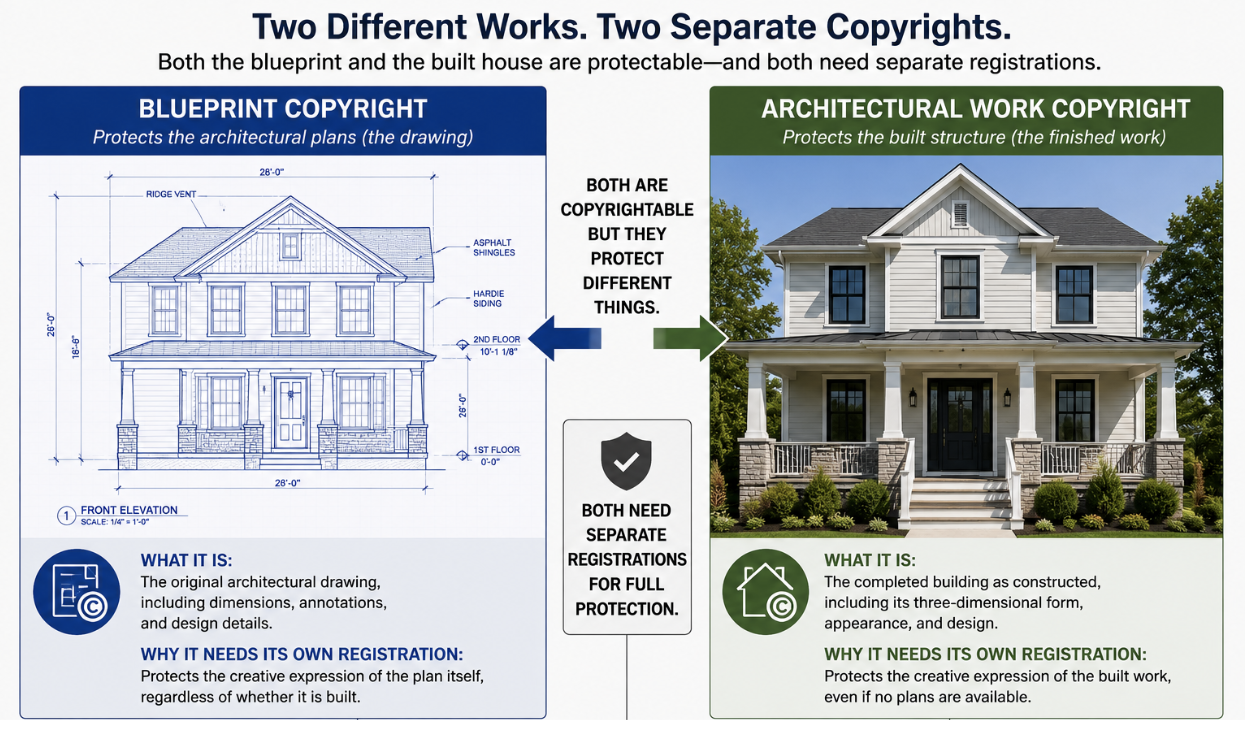
A common misconception in architectural copyright is that a copyright of the blueprints automatically covers the building. It does not. The technical drawings (blueprints/CAD files) are “pictorial, graphic, and sculptural works,” while the completed building is an “architectural work.” These are two separate copyrights, and the Copyright Office explicitly requires that claims for both be registered separately. An infringer who copies the building but never touched a set of plans may not be liable for infringing the technical drawings, and vice versa.
- Deposit Requirements
To register an architectural work, you must submit:
- One complete copy of the most finished architectural drawing, showing the external elevations from the front, rear, and all sides, as well as any interior arrangement of permanent walls dividing spaces (not furniture).
- If the building is constructed, photographs clearly showing multiple exterior and interior views.
- Any proprietary legends in the margins of the drawings should be uploaded as a separate file.
The deposit becomes part of the Library of Congress’s public record and cannot be returned. Electronic uploads under 500 MB are permitted through the online registration system. For most architectural work registrations, the electronic copy submitted with the application will satisfy the Library of Congress’s mandatory deposit requirement for unpublished works. If the work is published, the same electronic submission typically serves as the deposit, though the Library may later issue a formal demand for a physical copy of the best edition. No separate deposit action is required at the time of registration unless specifically requested.
Publication – When Does the Clock Start?
This may be the single most misunderstood concept in architectural copyright, and the one that creates the greatest litigation risk. “Publication” is the trigger that can start a three month countdown for your most powerful legal remedies. But in the architectural context, not everything you build or share is “published.”
So when is an architectural work published? Generally, when the plans are distributed to the general public by sale, rental, lease, or lending or multiple identical buildings are sold or leased to the public.
- Construction Alone is Not Publication
For architectural works created after December 1, 1990, the mere construction of a single building does not constitute publication. You can build a custom home, have it stand on a public street in plain view, and legally, the underlying design remains unpublished. Publication for an architectural work most commonly occurs when the underlying plans or drawings are distributed or made available to the general public by sale, rental, lease, lending, or an equivalent. However, the statute also recognizes a second, independent path to publication: the construction of multiple copies of a building and their sale or lease to the public. If a developer builds fifty identical homes in a subdivision and sells them, the architectural work itself is likely published by the transfer of the houses, regardless of what happened to the plans. For a single custom home, construction alone is not publication. But for repeated building, the completed structures themselves can start the clock.
A crucial caveat exists for historical works: if the plans were published, or the building was constructed, before December 1, 1990, the design is excluded from federal copyright protection entirely. The transitional rule is strict—building a single home before that date places the sign in the public domain for copyright purposes.
- The “Limited Publication” Safe Harbor
This is where a developer or architect can unknowingly protect themselves. The law recognizes a judge-made concept called the “limited publication” doctrine. If you share your plans with a small, select group for a specific, limited purpose, you have not published them to the general public. The doctrine was designed to prevent an author from losing rights simply by engaging in the ordinary process of getting a building constructed.
Distributing plans to a general contractor for pricing or to a structural engineer for review are classic examples of limited publication. Submission to a building department for permit approval, however, occupies a grayer zone. Many courts treat permit submissions as a limited publication because the purpose is specific and the audience is restricted. But the U.S. Copyright Office has historically taken the contrary view: that filing plans with a public agency, where they often become a public record, constitutes general publication. The majority judicial trend favors the limited-publication analysis, but the split in authority is real. A cautious architect should be aware that a permit filing could, in some jurisdictions, be deemed the act that triggers the three-month registration clock.
| Scenario | Architectural Work | Technical Drawing |
| Sharing plans with one general contractor for pricing | No publication: Limited disclosure to a single contractor for a specific purpose does not constitute general publication. | No publication: Same reasoning: restricted audience, limited purpose, no further distribution. |
| Sending to structural engineer for review | No publication: Professional review in confidence is not public distribution. | No publication: same reasoning |
| Submitting to building department for permit | Gray zone: Some courts say this is publication (because plans become public records subject to open records laws); others say no (because submission is a regulatory requirement, not a voluntary distribution to the public). The Copyright Office takes the position that submission to a government body for permit does constitute publication if the plans are available for public inspection. | Gray zone but different: For technical drawings, the analysis focuses on whether copies are made available to the public without restriction. If the building department allows anyone to request a copy of the plans, most courts find publication of the drawing. The Copyright Office agrees. |
| Posting CAD files on public website without password | High risk of publication: Because the architectural work is embodied in the CAD file. Once the file is publicly downloadable, the architectural work has been “published” (distributed to the public). | High risk of publication: Clear-cut: distributing copies of the drawing to anyone on the internet is classic general publication. |
- The Internet Wildcard
In the era of digital marketing, posting CAD files or detailed floor plans on a publicly accessible website creates a gray zone that is tilting toward risk. Some courts have held that when a file goes live on a website where users can view and download it, a general publication has occurred because the creator has lost the ability to control further distribution. Other courts defer to the applicant’s characterization of the work on the registration certificate, treating the question as fact-dependent and unresolved. The prudent approach? If you post plans online without a password-protected gate or a specific, restrictive license, a court may later find you’ve published the work and started a clock you didn’t know existed.
The Strategic Timing of Registration and Statutory Damages
A federal copyright exists the moment the design is fixed in a tangible medium. But you cannot file an infringement lawsuit without a registration certificate. More importantly, the timing of that registration determines whether you can access two specific weapons of copyright litigation: statutory damages and attorney’s fees.
- The Statutory Damages Bar: 17 U.S.C. § 412
17 U.S.C. § 412 draws a sharp line. If a work is unpublished, you cannot recover statutory damages or attorney’s fees for any infringement that commenced before the effective date of registration. If the work was published, you can only recover those remedies for post-publication, pre-registration infringement if you registered within three months of the first publication.
Failing to register within that three-month grace period doesn’t invalidate your copyright. You can still sue for actual damages and an injunction. But actual damages in an architectural case which is proving exactly how much profit the infringer made from your roofline are notoriously difficult to establish. Without statutory damages, litigation often becomes economically irrational.
- The “Limited Publication” Strategy
Because limited publication doesn’t start the three-month clock, a strategic copyright owner can discover an ongoing infringement, conduct a general publication (e.g. officially marketing the plans for sale to the public), and then register within three months. This move would make the owner eligible for statutory damages going forward, but only for new and separate acts of infringement committed by the defendant after registration.
If the infringer is simply continuing the same uninterrupted course of conduct that began before registration, for example, continuing to build out the same half-finished subdivision, many courts treat this as a single continuing infringement. Those post-registration acts will not support statutory damages. To reset the liability landscape, you need the infringer to do something new, such as beginning a fresh project on a different lot, or continuing unauthorized construction after receiving a clear cease-and-desist letter.
- Don’t Waive the Defense
An important tactical note for defendants: § 412 operates similarly to an affirmative defense. If a defendant fails to raise it in a timely manner during litigation, it is waived. A plaintiff who registered late may still win statutory damages by default if the defense attorney isn’t paying attention.
There is no independent one-month grace period for attorney’s fees tied to discovery of the infringement. Under 17 U.S.C. § 412, if a work is unpublished and the infringement begins before registration, both statutory damages and attorney’s fees are barred for that infringement. If the work is published, the three-month post-publication window applies equally to both statutory damages and attorney’s fees.
Section 505, which gives courts discretion to award attorney’s fees to the prevailing party, does not override § 412’s timing bar. The practical takeaway is unforgiving: if you miss the registration window, you lose access to both weapons simultaneously. The only reliable path to preserving both remedies is timely registration, either before infringement begins, or within three months of first publication.
How Can Saper Law Assist?
If you have questions about protecting your copyrights, contact Saper Law at 312 527 4100. If you need more specific guidance depending on the unique details of your case, you can book a consultation call with a Saper Law attorney here.